



Functional QA testing is the cornerstone of our process. It's where we meticulously test every aspect of your game's functionality, ensuring that all features work as intended and provide a smooth, enjoyable experience for your players. We go beyond basic functionality checks, exploring edge cases and user scenarios to identify even the most subtle bugs. This rigorous approach prevents frustrating glitches and ensures a polished, professional product that leaves a lasting positive impression on your players.
What we test:
Game mechanics and rules
User interface (UI) and user experience (UX)
In-game purchases and transactions
Progression and save systems
Multiplayer functionality (if applicable)
Functional Quality Assurance (FQA) is the discipline of verifying that every feature, mechanic, and system in a game does what it's supposed to do—both when players follow the intended path and when they do things nobody planned for.
Playing a game means following the designed experience. Testing a game means challenging that experience from every possible angle.


Guaranteeing test coverage
Confirming Testing Setup & Mode
Establishing Quality & Bug Reporting Standards
LQA Execution Phase
Post-Execution: Regression & Live-Ops Support (Enhanced)
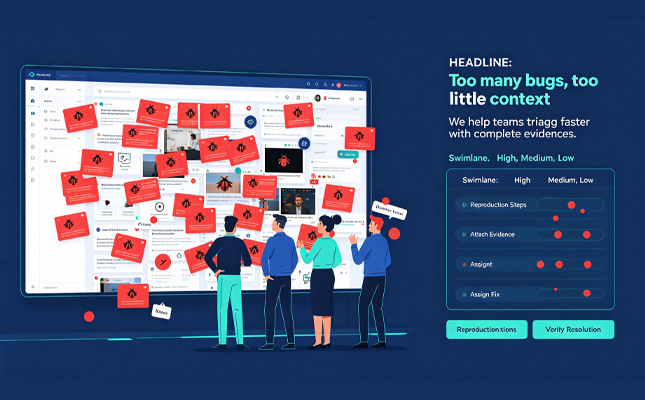
Modern games generate thousands of issues during testing—and that's before player reports flood in. Spreadsheets and email threads collapse under the weight. Teams spend more time managing bug reports than fixing them. Our strength: Structured, actionable bug reporting with clear severity prioritization. Every bug comes with reproduction steps, screenshots, and video capture—so your developers fix issues, not decipher reports. No chaos. No "what does this mean?" conversations.
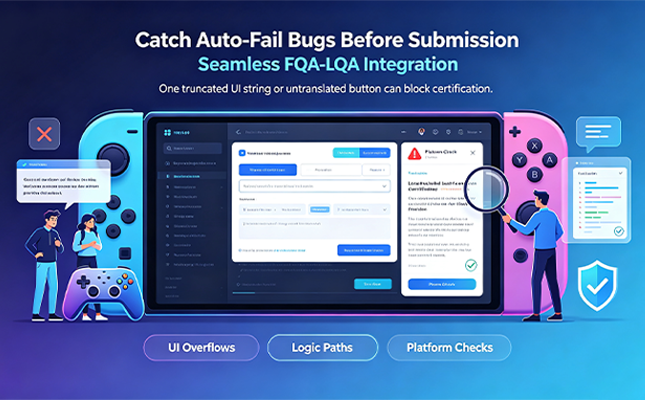
Platform holders have automated LQA checks. A single truncated UI string or untranslated button can trigger an automatic fail, costing you time, money, and your launch window. Standard functional QA often misses these issues because they only appear after localization is integrated. Our strength: Seamless FQA-LQA integration. We test how localized content interacts with gameplay—identifying UI overflows, broken logic paths, and platform-specific issues that standard QA overlooks. We catch the bugs that auto-fail platform checks before submission.
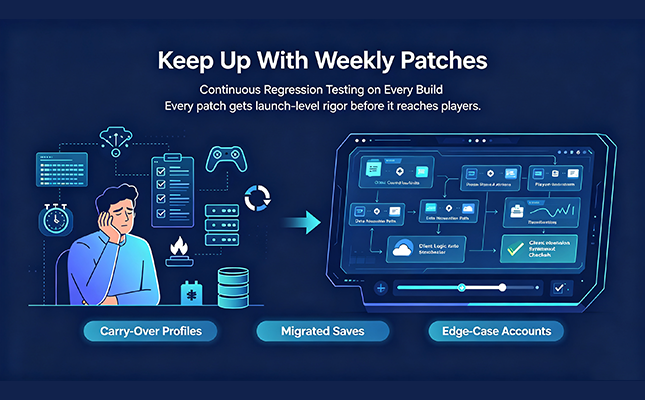
Games-as-a-Service has killed the "ship it and move on" model. Weekly or even daily updates require regression testing at speeds manual teams simply cannot achieve without burnout or blind spots. LiveOps failures rarely come from obvious code defects—they emerge from state carry-over, schema mismatches, and timing drift between data and client logic. Our strength: Continuous regression testing on every build. Every patch is treated with the same rigor as the original launch. We simulate persistence across multiple patches—testing carry-over profiles, migrated saves, and edge-case accounts.
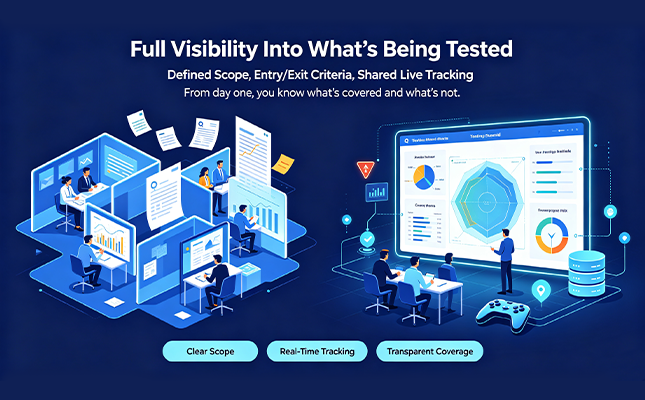
QA teams work in silos. Test cases get lost in email threads. Project managers struggle to get real-time insights. Late-stage testing cycles mean problems surface when there's no time left to fix them. Our strength: Defined scope, entry/exit criteria, and shared live tracking from day one. You know exactly what's being tested, what's covered, and what's not—full transparency throughout the process.
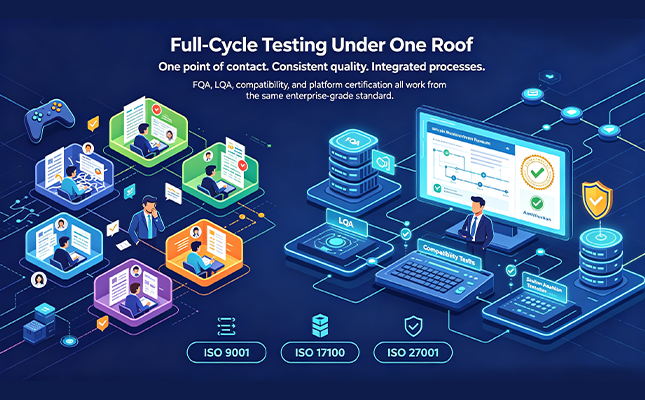
One vendor for FQA. Another for LQA. A third for compatibility testing. Each with different standards, different reporting formats, different points of contact. The overhead alone is exhausting—and quality suffers when nothing is integrated. Our strength: Full-cycle testing under one roof. FQA + LQA + compatibility + platform certification—all integrated, all consistent, all managed through a single point of contact. Our Triple ISO-certified processes (ISO 9001, ISO 17100, ISO 27001) ensure every test phase meets the same enterprise-grade standard.
Ready to unlock the power of global communication? Contact us today for a free consultation and discover how WeMaven can help you achieve your international business goals.
Functional Quality Assurance (FQA) is the systematic process of verifying that every feature, mechanic, and system in a game does what it's supposed to do—both when players follow the intended path and when they do things nobody planned for. It's not "playing games for a living." It's methodically challenging every system, edge case, and interaction to uncover what breaks.
Why your dev team can't do this alone: Developers are too close to the code. They know how things are supposed to work, so they tend to test along the happy path. FQA testers think like players—they spam buttons during cutscenes, quit mid-save, stress-test inventory limits. They find the breaks that developers never see coming.
A recent industry survey found that 77% of developers admit they don't test their games enough, and only 23% are confident in the quality of what they release. Don't be part of that statistic.
Games-as-a-Service has fundamentally changed QA. It's no longer a one-time milestone—it's a continuous process.
Every patch, season, or hotfix introduces new content, new features, and new regression risks. A balance patch might break progression logic. A new battle pass might corrupt save states. A UI update might introduce layout violations that only appear in specific languages.
WeMaven provides continuous FQA support for live-ops titles—testing every update with the same rigor as the original launch, so your weekly cadence doesn't become your weekly nightmare.
AI and automation are powerful tools—but they have serious limitations.
What AI can do: Run repetitive regression tests, identify visual artifacts, and flag performance anomalies. AI can test at scale in ways manual testing never could.
What AI can't do: Understand game rules, conduct targeted functionality testing, or assess whether something feels fun. Bot behavior is essentially random or preset—it can't explore creatively or identify subtle gameplay issues. According to the 2026 State of the Game Industry Report, 52% of the workforce now holds explicitly negative views regarding AI technology. Players can smell when a game hasn't been thoughtfully playtested by humans.
We use AI for what it's good at—speed and scale—but we never replace human testers. Your game needs both.
Multi-platform testing is one of the biggest operational challenges in game development. Each platform has different hardware, certification requirements and failure modes.
What we test:
Console – PlayStation, Xbox, Nintendo—each with specific TRC/TCR/Lotcheck requirements
PC – Multiple configurations, GPU models, and operating systems
Mobile – Android and iOS devices with varying screen sizes, processors, and OS versions
A game that runs perfectly on your dev kit can still fail on consumer hardware. We test on the devices your players actually use.
FQA and LQA are often treated as separate services—but separating them can actually hurt publishers and developers. Many boutique or "à la carte" companies have fragmented the market, forcing publishers to rely on multiple partners to complete a single game.
The reality: Localization bugs are functional bugs. A translated string that overflows the UI is a functional failure. A mistranslated prompt that breaks a quest is a functional failure. A cultural misstep that offends players is a functional failure of the game experience.
One vendor. One standard. One QA workflow that covers everything. And when FQA and LQA operate together, patterns emerge faster, and fixes become clearer.
Playing a game means following the intended path. Testing a game means challenging that experience from every possible angle.
A player plays through a level, follows the objectives, and moves on.
An FQA tester asks: What happens if I skip this dialogue and trigger the next quest simultaneously? What breaks if I save and reload in the middle of this cutscene? What fails if I combine these two systems in a way the designer never anticipated?
Exploratory testing exposes usability breakdowns, progression stalls, and soft-locks when players act "outside the script." That's exactly what your players will do on day one.
FQA catches the bugs that players will find—and the ones they won't forgive. Here's what we routinely uncover:
The cost of poor quality is far higher than the cost of good QA.
What's at stake:
Negative reviews – A buggy launch can tank your review scores permanently. A drop from a 4-star to a 3-star rating can reduce user adoption from 95% to 50%.
Refund requests – Players don't tolerate broken experiences.
Brand damage – One bad launch can haunt a studio for years.
Lost revenue – Players who quit due to bugs may never come back. Nearly 25% of players may abandon a brand entirely after a single crash.
Certification rejection – Platform re-submission fees and delayed launch windows.
FQA isn't an expense—it's insurance against a failed launch.
Our numbers:
600+ titles LQA'd and stress-tested
500+ titles fully localized
99.1% on-time delivery over the past three years—even with surprise 48-hour patches
80+ languages supported
Triple ISO-certified – ISO 9001 (Quality) • ISO 17100 (Translation) • ISO 27001 (Security)
We don't make promises we can't keep. Our track record speaks for itself. And our ISO certifications mean your IP and data are secure, your processes are audited, and your quality standards are guaranteed.
Panic is not a strategy. We are.
Our rapid response capability:

Curious about how localization can help your business? Have questions about our services or rates? Fill out the form below, and our team will be happy to assist you.
Get instant answers to your questions about global expansion, localization costs, QA testing, and more. Our team of localization experts is ready to help you unlock your business's full potential in international markets. Click the button below to start a WhatsApp chat.