


Beyond functionality, we understand the critical importance of linguistic accuracy and cultural relevance. Our LQA testing goes beyond simple grammar and spelling checks. Our expert linguists immerse themselves in your game, ensuring that the translation is not only accurate but also culturally appropriate and engaging for your target audience. We focus on ensuring a natural and immersive experience that resonates with players and avoids any potentially offensive or confusing elements.
What we test:
Accuracy and fluency of translations
Cultural appropriateness of text and dialogue
Consistency of terminology and style
Voice-over quality and synchronization
Localization of UI elements
Localization Quality Assurance (LQA) is the process of testing a fully localized game in its playable environment to verify that translated text, audio, UI, and cultural elements function and resonate as intended for each target market.
Translation alone is not enough. A grammatically correct translation can still break the game—text can overflow UI buttons, mistranslated prompts can block progression, and culturally inappropriate content can alienate entire regions. LQA bridges the gap between what the translation says and how the game actually feels when played by native speakers in their own language.
In short: LQA answers one critical question—does your game deliver the same experience in every language that it delivers in the original?


Assign a dedicated Project Manager as a single point of contact
Review and align glossaries, style guides, and lore documentation
Define entry criteria, scope, and test coverage
Set up testing environments and hardware
Define bug severity and priority standards
Onboard testers and conduct project kick-off
Execute LQA testing across all target languages and platforms
Document and report bugs with actionable detail
Work with your dev team to validate fixes
Run regression testing and deliver final sign-off
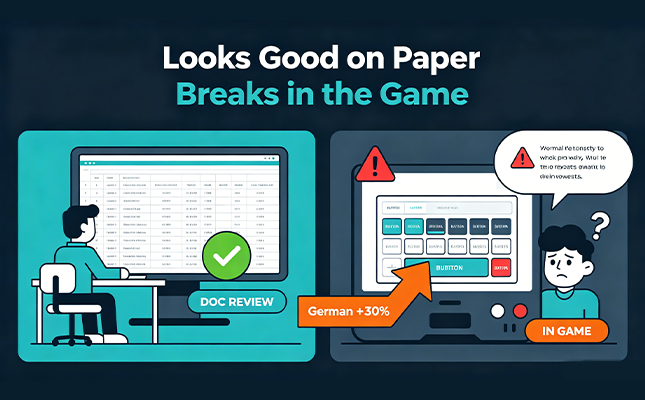
Translation review happens in isolation. Reviewers look at text strings without context, often missing issues that only appear when the game is actually played. A grammatically correct translation can still break UI, block progression, or feel completely wrong to a native-speaking player. Our strength: We test every localized asset in the game environment—UI text, subtitles, audio, and cultural elements—exactly as players will experience them. Our native-speaking testers play through your game on real hardware, identifying truncation, text overflow, font rendering issues, and context errors that no document review could ever catch. A button label that fits in English often overflows in German because text expansion can reach 30% or more. We catch those breaks before players do.
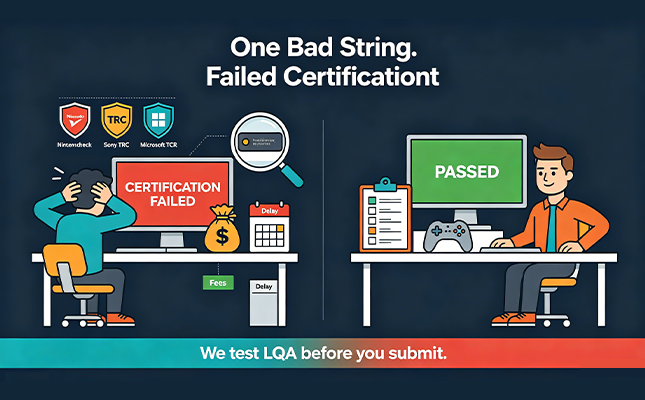
Platform holders have automated LQA checks. A single truncated string, untranslated button, or text overflow can trigger an automatic certification fail—costing you re-submission fees and pushing back your launch window. Nintendo's Lotcheck, Sony's TRC, and Microsoft's TCR all have explicit localization requirements that must be met. And production teams consistently underestimate how platform certification amplifies localization risks. Our strength: We test against platform-specific LQA requirements before you submit. We catch text truncation, UI overflow, font rendering errors, and encoding problems that would otherwise get your build rejected. We know exactly what each platform requires—and we verify it.
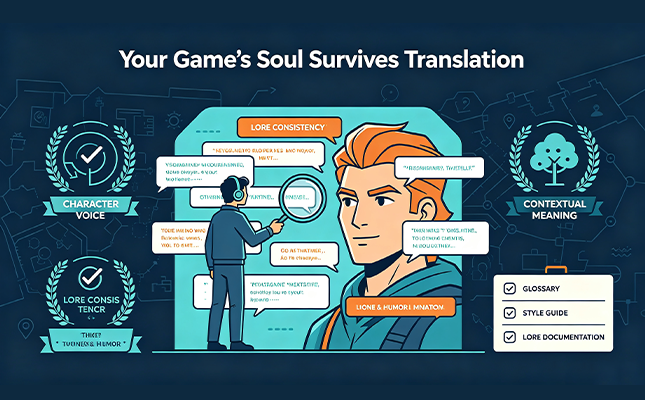
Games are storytelling mediums. Characters have distinct voices. Lore has internal consistency. Humor, tone, and emotional intent are deeply contextual—and automation tools don't recognize them. A line that is technically "correct" may still sound awkward or out of character to a human player. Cultural references may technically "translate," but fail to land. Our strength: Our testers are genre specialists who understand narrative depth. They verify that dialogue fits the pacing of gameplay, that character voices remain consistent across scenes, that tutorial instructions feel natural under pressure—and that your game's soul survives translation. We enforce glossaries, style guides, and lore documentation across every language and every update.
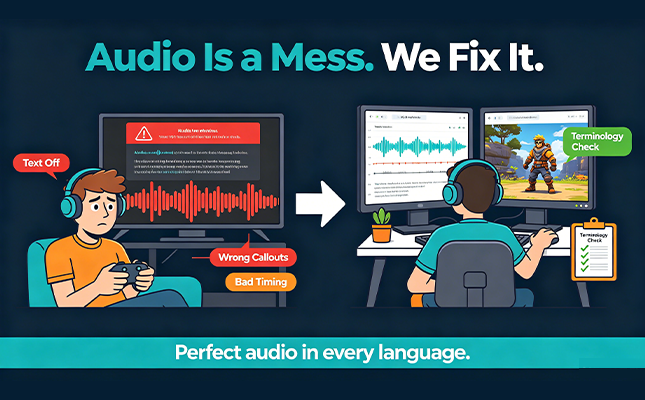
Audio and voice-over are often overlooked in LQA—but players notice immediately. Misaligned voice lines, English callouts over localized subtitles, inconsistent terminology between UI and spoken dialogue—these issues create a disjointed experience that players won't forgive. Our strength: We systematically test audio and subtitle synchronization, voice line consistency, and terminology alignment across all spoken and written content. We verify that your characters sound like themselves in every language, and that what players hear matches what they read.
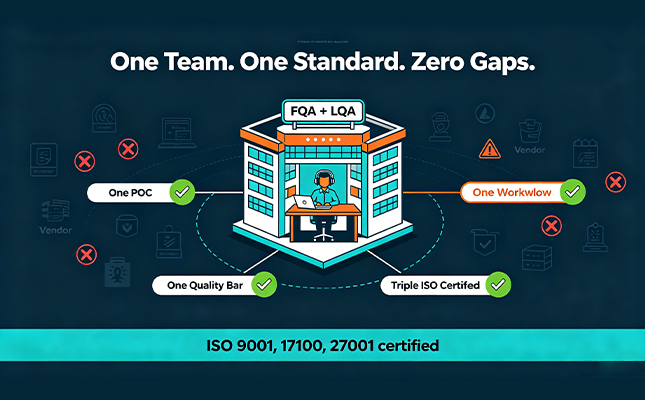
In the margin-critical global game publishing of 2026, fragmented vendor deliverables are a direct threat to your launch velocity. Managing multiple external localization vendors creates communication barriers, varying demands, and disparities in quality standards. One of the most prevalent hidden issues is a lack of consistency in how vendors evaluate quality. Our strength: We provide integrated FQA and LQA under one roof—because localization bugs are functional bugs, and functional bugs break localization. One POC. One quality bar. One workflow that covers everything. And we're triple ISO-certified (9001, 17100, 27001)—so you're not just taking our word for it.
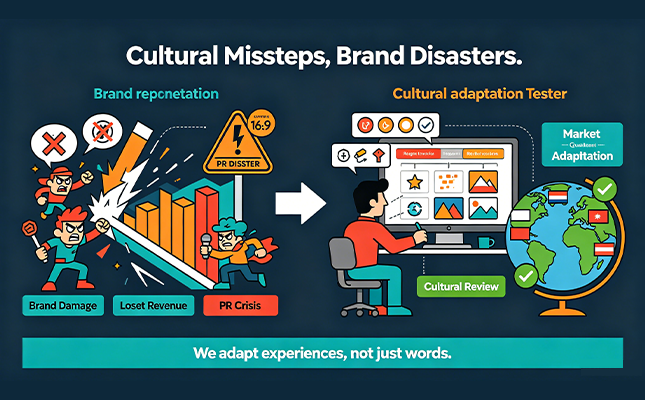
Cultural missteps don't just hurt feelings—they damage brands and destroy revenue. Consider the fighting game that had to rename a new character after discovering that the intended hero name was a homophone for a highly offensive word in Turkish. Or Cyberpunk 2077, whose Ukrainian localization included derogatory terms and unsanctioned political references that the developer had to publicly apologize for and remove. Or Minecraft Legends, whose Arabic translation was so bad it was "unusable" and forced players to use English instead. Our strength: Our testers identify and correct references, symbols, humor, and imagery that may offend or confuse players in specific markets. We don't just translate words—we adapt experiences. We catch the cultural misfires that would otherwise become PR disasters.
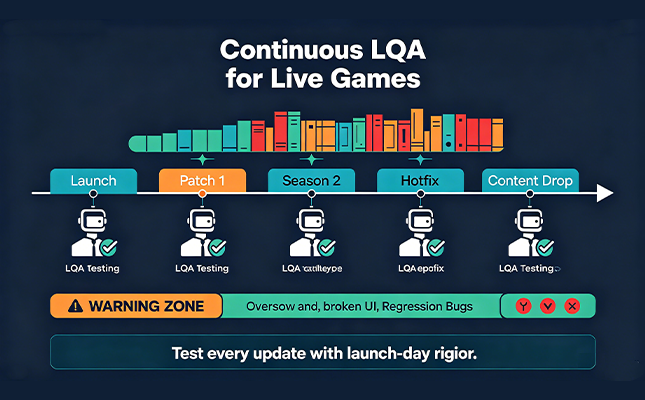
Games-as-a-Service has fundamentally changed LQA. It's no longer a one-time milestone—it's a continuous process. Every patch, season, or hotfix introduces new text, new features, and new regression risks. And with game complexity increasing, text overflow issues, context-dependent translations, and cultural adaptation needs require specialized LQA expertise to resolve. Our strength: We provide ongoing LQA support for patches, seasons, and content drops—testing every update with the same rigor as the original launch. We build a knowledge base (glossaries, style guides, translation memories) that makes future updates faster and more accurate.
Ready to unlock the power of global communication? Contact us today for a free consultation and discover how WeMaven can help you achieve your international business goals.
Even the best translators work with limited context. They see text strings in isolation—a spreadsheet column labeled "Start," a JSON key called "quest_complete_text." They don't see the button it goes on, the screen it appears in, or the character who says it.
A translator might translate "Start" as "开始" (begin). But in the game, that button might start a battle, start matchmaking, start building, or start playing a cutscene—each requiring a different expression in many languages. Without context, the translator has to guess.
LQA puts that translation into the game and verifies it works. It catches what the translator couldn't see. We've tested 600+ titles—and in nearly every one, we found issues that translation alone missed.
LQA isn't a critique of your translators. It's a safety net for your launch.
LQA is typically billed by the hour, with rates ranging from roughly $25 to $80 per hour, depending on the tester's experience, language pair, and platform complexity. For some languages—particularly Chinese and Japanese—LQA costs can approach or even double the total cost of translation.
Platform complexity also significantly affects cost. Console LQA is generally more expensive than mobile due to stricter certification requirements and platform-specific testing. The Nintendo Switch, for example, supports 16 system languages—including Simplified and Traditional Chinese, Korean, and Arabic—each with distinct font, layout, and rendering requirements.
The real question isn't "how much does LQA cost?"—it's "how much does skipping LQA cost?" A single certification rejection can cost $25,000–$50,000 in re-submission fees and lost revenue from a delayed launch. That's more than most LQA budgets.
If you're launching exclusively in English and have no plans to localize, you don't need LQA.
But two things to consider:
First, many studios plan "English-only" launches and then scramble to localize when they see unexpected demand in non-English markets. By then, you're rushing to localize without proper LQA—and that's when mistakes happen.
Second, even English-only games have global audiences. Players in non-English markets may still play your game with English text. If the English UI has clarity issues or bugs, they'll run into them too.
If you're certain you'll never localize, skip LQA. If there's even a chance you'll expand to other markets, plan LQA into your schedule. Last-minute LQA reduces effectiveness—found issues may not have time to be fixed before launch.
You can. But there are three challenges:
Narrative-heavy games (RPGs, visual novels, story-driven adventures) require testers who understand not just the language, but the world.
A tester needs to know:
LQA identifies what's wrong—translation errors, UI bugs, inconsistent terminology.
Cultural consulting identifies what could go wrong—cultural taboos, offensive imagery, inappropriate humor, religious sensitivities.
An LQA tester might flag that a character's dialogue is grammatically incorrect. A cultural consultant might flag that the same character's design or gestures are offensive in a specific market—even if the translation is technically perfect.
Real example: A German LQA tester once flagged the translation of "leader" as "Korpsanführer"—a word associated with the Nazi regime that would have invoked a strongly negative connotation for German players, completely unintentionally in the original script. A cultural consultant would have caught this even earlier, at the design stage.
You need both. LQA ensures the translation is correct. Cultural consulting ensures it's appropriate. We offer both—and we integrate them into a single workflow, so nothing falls through the cracks.
Games-as-a-Service has fundamentally changed LQA. It's no longer a one-time milestone—it's a continuous process.
Every patch, season, or hotfix introduces new text, new features, and new regression risks. A balance patch might change item descriptions that were already localized. A new character might introduce lore terms that conflict with existing terminology. A UI update might introduce layout violations that only appear in specific languages.
The problem: Most LQA vendors treat each update as a new project—new kick-off, new onboarding, new billing. The result? Inconsistent quality, slow turnaround, and producers drowning in vendor management.
Our approach: Continuous LQA support for live-ops titles. We build a knowledge base (glossaries, style guides, translation memories) that makes future updates faster and more accurate. We test every update with the same rigor as the original launch—so your weekly cadence doesn't become your weekly nightmare.
Absolutely. LQA issues are one of the most common causes of certification rejection.
Platform holders—Sony (TRC), Microsoft (TCR), and Nintendo (Lotcheck)—all have explicit localization requirements. Nintendo requires that "strings must not overflow UI containers." If translation of a specific term doesn't strictly match the platform's official Naming Conventions, the platform holder will not certify the game.
Common certification failures caused by localization:
No. AI can assist—but it cannot replace human judgment in LQA.
What AI can do: Run repetitive checks, flag potential display issues, and identify obvious spelling or grammar errors at scale.
What AI cannot do:
The cost of poor localization is far higher than the cost of good LQA.
What's at stake:

Curious about how localization can help your business? Have questions about our services or rates? Fill out the form below, and our team will be happy to assist you.
Get instant answers to your questions about global expansion, localization costs, QA testing, and more. Our team of localization experts is ready to help you unlock your business's full potential in international markets. Click the button below to start a WhatsApp chat.